
Aman earned more money than he had ever earned before, but on the 27th of every month he still opened his banking app with the same feeling: a small pressure in the chest, a quick calculation in the mind, and a quiet hope that salary day would arrive before some new bill did.
Nothing dramatic had happened. No one stole from him. No emergency destroyed his account. His life looked better than before. He had a cleaner apartment, better clothes, newer subscriptions, more dinners outside, and a phone he had upgraded because everyone around him seemed to upgrade without thinking.
But the strange thing was this: the raise that was supposed to make him free had only made his lifestyle heavier.
One Sunday morning, Aman sat with his notebook, a glass jar of coins, and three unopened envelopes on his desk. He wrote his salary at the top of the page. Then rent. Food. EMIs. Cards. Apps. Shopping. Travel. Small impulse expenses he could barely remember. At the bottom, where savings were supposed to be, he wrote a number so small it felt insulting.
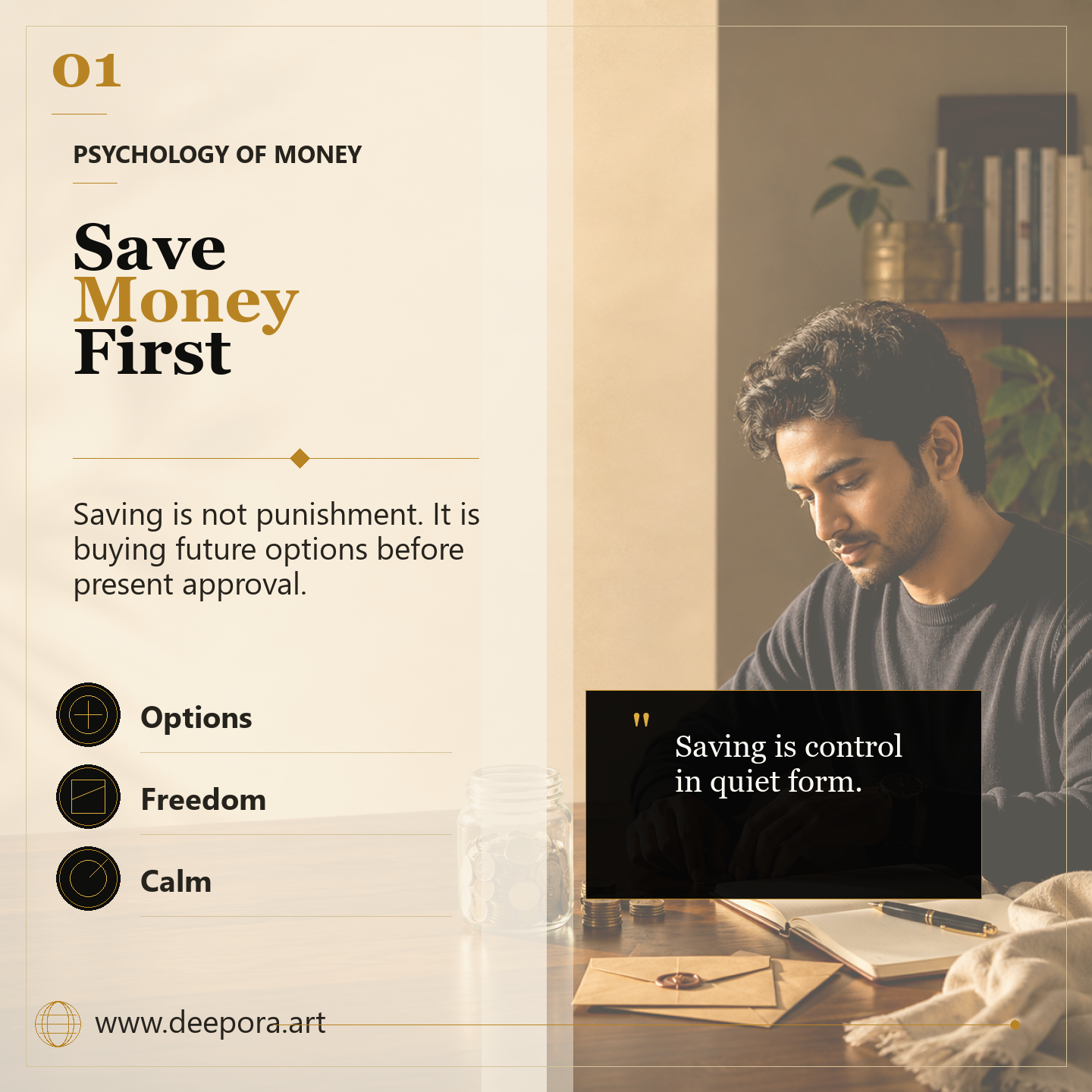
That was the day he understood one of the most important lessons from Morgan Housel's The Psychology of Money: saving money is not about being cheap. Saving money is about buying future freedom before present approval consumes it.

The Core Idea: Saving Is Stored Choice
Most people treat saving as the money left after spending. That sounds practical, but it is usually backwards. When saving depends on what is left, the world gets the first claim on your income: brands, bills, social pressure, sales, upgrades, and the version of you that wants comfort right now.
The save money lesson in The Psychology of Money is deeper than a budgeting trick. Housel's larger argument is that wealth is not just numbers in an account. Wealth is the set of options those numbers quietly create. Savings buy time. Savings buy patience. Savings buy the ability to wait, to leave, to say no, to recover, and to choose without panic.
That means saving is not only a financial habit. It is a psychological boundary. It tells the present, "You do not get everything. Some part of this income belongs to the future."

Why More Income Does Not Automatically Create Wealth
Aman's mistake was not that he earned too little. His mistake was that every increase in income became permission to increase fixed expenses. A better salary became a better apartment. A bonus became a gadget. A raise became a bigger weekend habit. He was not becoming wealthier. He was becoming more expensive to maintain.
This is why two people with the same income can live completely different lives. One person has money but no freedom because every rupee is already promised to a bill. Another person has less visible luxury but more choices because they keep a gap between income and lifestyle.
| Spending-first life | Saving-first life |
|---|---|
| Saves whatever is left at the end. | Saves before lifestyle gets a vote. |
| Raises quickly become new fixed costs. | Raises first increase the freedom gap. |
| Looks richer from outside. | Becomes stronger from inside. |
| Emergency creates panic. | Emergency becomes manageable. |
| Money buys approval. | Money buys options. |
The Gap Is Where Wealth Begins
There are three different things people often mix together: income, wealth, and freedom.
| Concept | What it means | Common mistake |
|---|---|---|
| Income | Money entering your life. | Thinking a high salary automatically means wealth. |
| Wealth | Money not yet spent. | Judging it by visible purchases. |
| Freedom | The control savings give you over future choices. | Ignoring it because it is invisible. |
Aman used to think wealth was something people could see. Then he noticed the people he respected most were often not the loudest spenders. They had cash buffers, low fixed costs, fewer urgent decisions, and more patience. They could wait for better opportunities because they were not forced into every available option.
That is the quiet power of saving. It gives you room. Room to think. Room to make mistakes. Room to avoid desperate choices. Room to let compounding work. Room to build something slowly instead of chasing every short-term fix.

What Saving Really Buys
Saving looks boring because the reward is not always visible today. A new purchase gives instant proof. A saved rupee gives future power. That future power is easy to underestimate because it has no packaging, no applause, and no photo for social media.
| Saving looks like | It actually buys |
|---|---|
| Not upgrading immediately. | Freedom from unnecessary fixed costs. |
| Keeping cash aside. | Calm when life becomes unpredictable. |
| Automating a monthly transfer. | Discipline without daily negotiation. |
| Delaying a purchase. | Proof that desire is not always command. |
| Living below your income. | Options that other people may not have. |
10 Lessons From The Save Money Principle
1. Saving is not punishment
If saving feels like punishment, it usually means spending has been given the role of comfort, identity, and reward. Saving is not saying no to life. It is saying yes to a future where you are less trapped.
2. Wealth begins in the gap
The gap between what you earn and what you spend is the real engine. Without that gap, even a large income can become fragile. With that gap, even moderate income can slowly become powerful.
3. Pay your future first
Aman changed his system by moving savings on salary day, not at month end. This removed the argument. The money left after saving became the real spending limit.
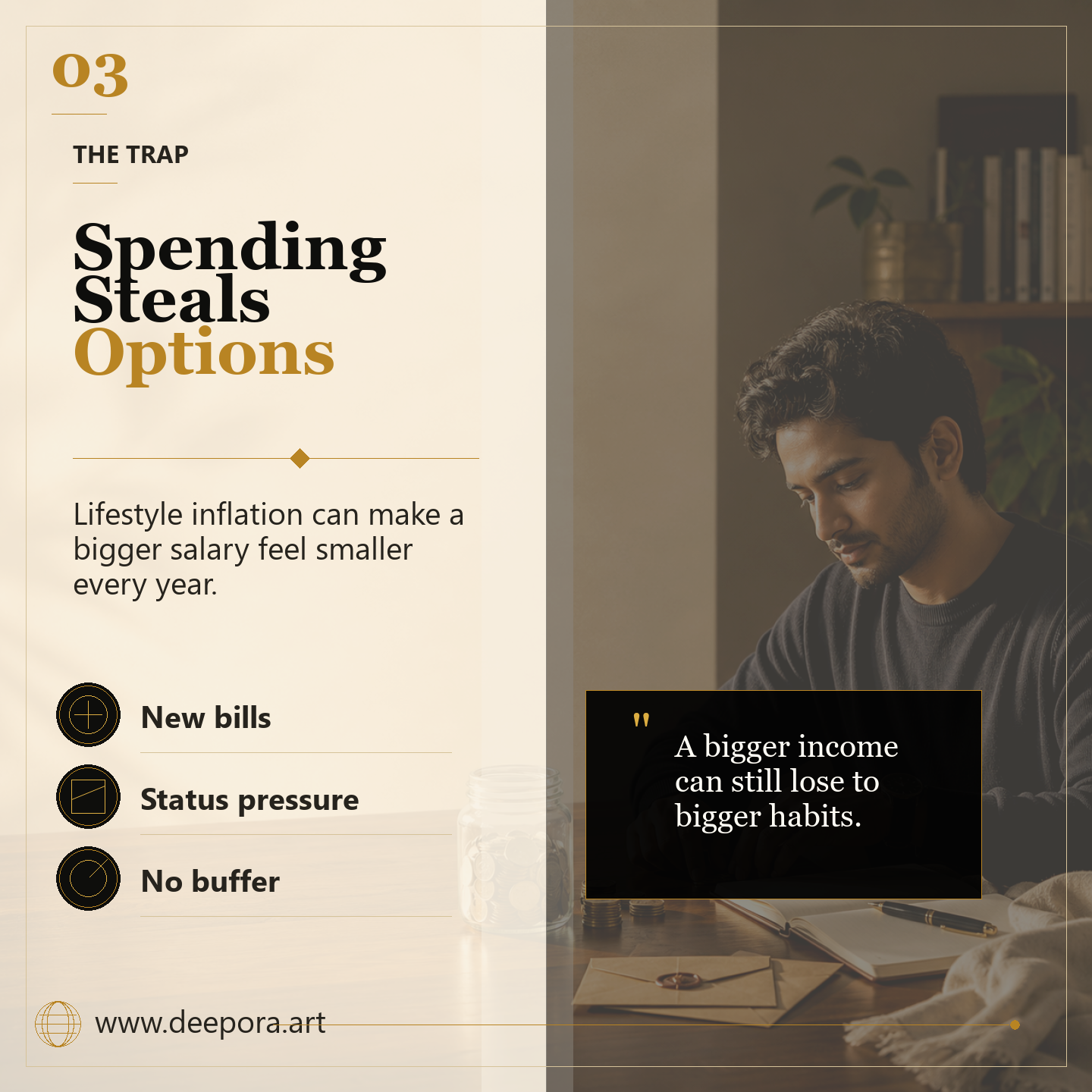
4. Lifestyle inflation steals options quietly
One new bill does not feel dangerous. Ten new fixed costs create a life that needs constant income just to stay still. The trap is quiet because each upgrade feels reasonable alone.
5. A small buffer changes behavior
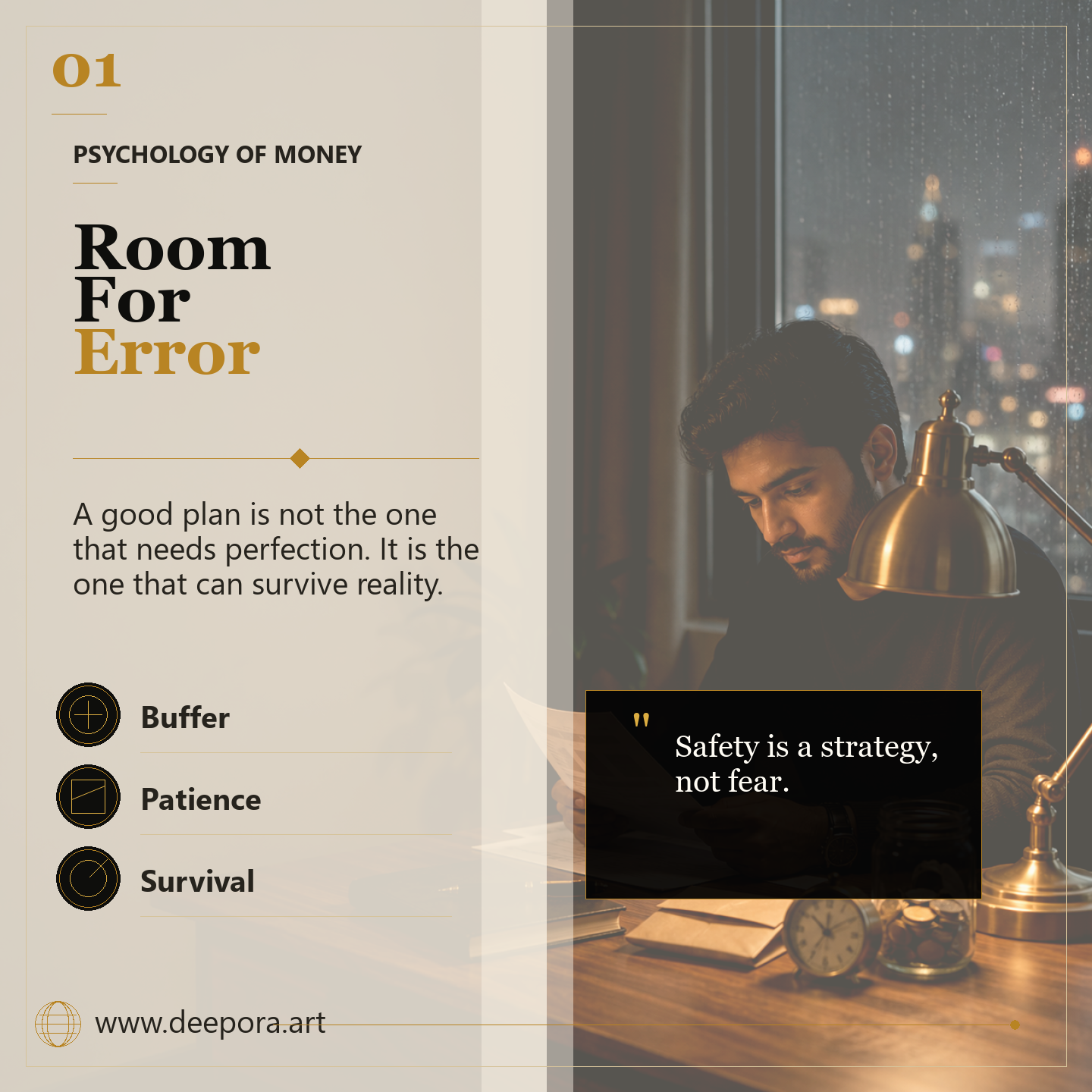
Even one month of expenses saved can change how you think. It makes you less reactive. It gives you the courage to negotiate, pause, and choose better.
6. Freedom is built before it is felt
You do not feel rich the day you save your first small amount. But the invisible habit is building a future advantage. Most real freedom is constructed before it becomes visible.
7. Saving gives courage
Money in reserve can give you the courage to leave a bad job, reject a bad deal, take time to learn, or survive a slow season without losing your mind.
8. Spend on values, cut status
The goal is not to hate spending. The goal is to stop spending for borrowed approval. Spend where it genuinely improves your life. Cut where it only performs an image.
9. Automate discipline
If every month depends on motivation, the system is weak. Automation makes saving happen before mood, stress, or impulse can interfere.
10. Saving protects compounding
Compounding needs time. Savings protect that time. Without a buffer, people often break investments early because life interrupts the plan.

A Practical Framework: The Freedom Gap
For the next 30 days, do not start with a complicated budget. Start with one number: your freedom gap.
- Write your monthly income. Use the money that actually reaches your account.
- Write your unavoidable costs. Rent, food, utilities, EMI, transport, insurance, basic family responsibilities.
- Write your flexible spending. Eating out, shopping, apps, upgrades, convenience spends, impulse purchases.
- Choose one automatic saving amount. Move it on payday, even if it starts small.
- Delay one upgrade for 30 days. If you still want it later and it fits your gap, decide calmly.
The point is not perfection. The point is control. Once Aman saw the gap, he stopped blaming income for every problem. Some problems were income problems. But many were structure problems.
Internal Reading Path
If this lesson connects with you, read it with these Deepora guides next: Wealth Is What You Do Not See, Control Your Time, Room for Error, and Compounding. Together, they form a simple money system: keep the gap, protect the gap, and let time work on the gap.
FAQs
What is the save money lesson in The Psychology of Money?
The lesson is that saving is not only about a future purchase. It is about independence, flexibility, and options. The money you do not spend can become control over your future decisions.
Should I save money before investing?
In most real lives, a basic cash buffer comes first because it protects you from selling investments at the wrong time. After that, saving and investing can work together.
How much money should I save every month?
There is no single perfect number. Start with an amount you can repeat. Then increase it when income rises or unnecessary expenses reduce. Consistency matters more than a heroic first month.
Is saving money enough to become wealthy?
Saving alone may not be enough, but it is the foundation. Without saving, there is no capital to invest, no buffer for mistakes, and no patience for compounding.
Reflection Prompt
Look at one purchase, subscription, or upgrade from the last 30 days. Did it improve your life, or did it only protect an image? What would happen if that money became part of your freedom gap instead?

Conclusion: Save Money To Buy Back Choice
Aman did not fix his life by becoming extreme. He fixed the order. Savings moved first. Lifestyle adjusted second. Over time, that one change made his money feel less like a monthly visitor and more like a tool he could use.
The real psychology of saving money is simple: the world will always give you reasons to spend now. Your job is to keep enough money aside that future you still has choices.
Deepora CTA: Read one money lesson, apply one small system, and protect the gap before the next upgrade asks for it.
Source and credit: This article is an independent Deepora educational interpretation inspired by ideas from Morgan Housel's The Psychology of Money. It is not financial advice. Use it as a thinking framework and adapt decisions to your own income, responsibilities, risk, and local financial context.


0 Comments