
At 9:12 p.m., Nikhil sat at his desk while rain hit the window and his phone kept lighting up with unpaid reminders.
Three months earlier, his money plan had looked perfect. Salary on the first. Rent on the fifth. EMI on the seventh. Credit card payment on the tenth. Investment SIP on the fifteenth. A small weekend budget. A small eating-out budget. A small everything budget.
On paper, nothing was wrong.
Then reality arrived without asking permission. His company delayed salaries by two weeks. His mother needed tests. His bike needed repair. A client payment he was expecting from freelance work got postponed. None of these events was unusual. That was the painful part. His plan did not fail because something impossible happened. His plan failed because normal life happened.
Nikhil looked at the spreadsheet and finally understood the mistake: he had built a perfect plan, not a survivable one.
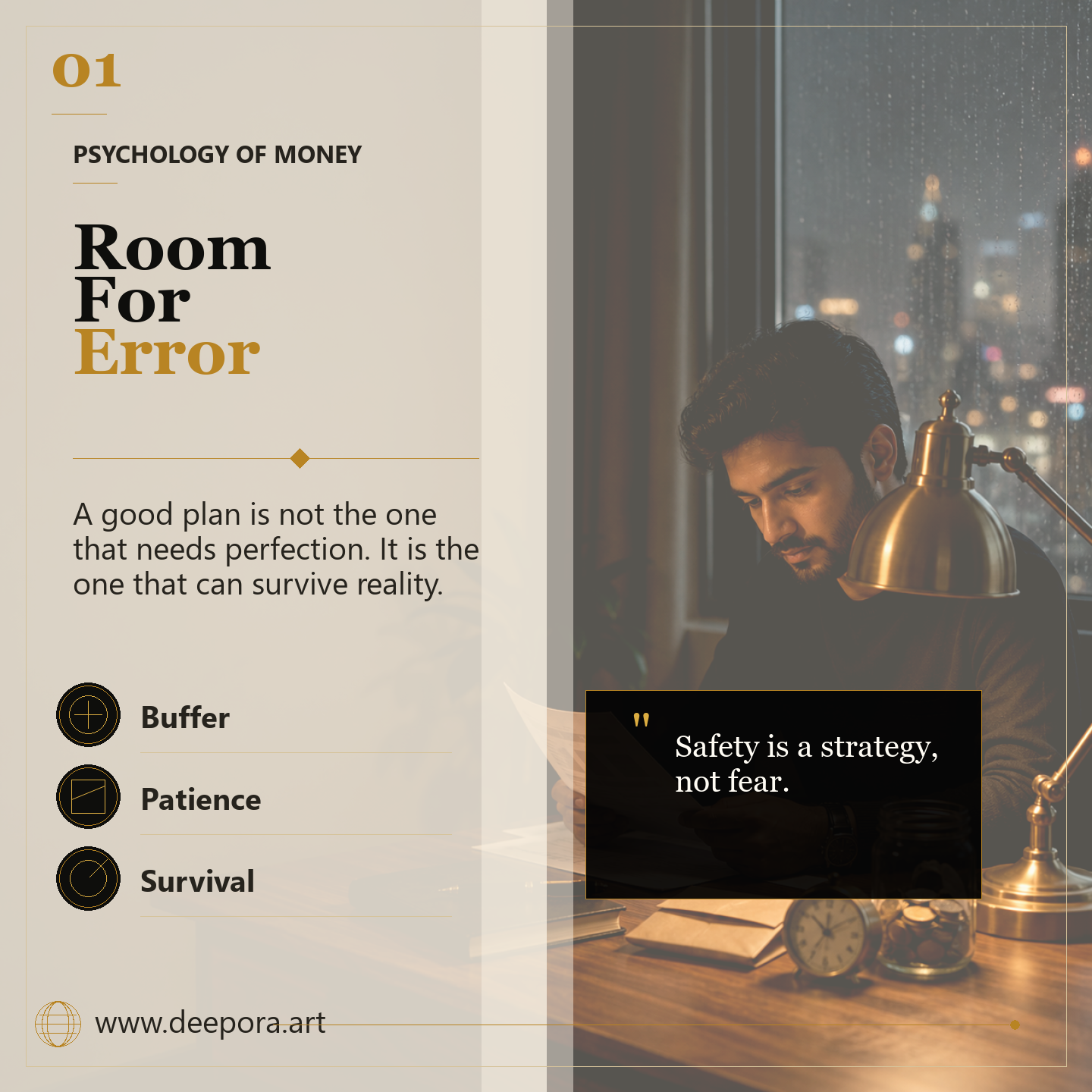
This is the core of the room for error lesson from The Psychology of Money by Morgan Housel. A good financial plan is not the one that needs everything to go right. A good plan is the one that can survive when a few things go wrong.
What Room For Error Really Means
Room for error is the gap between what you expect and what life may actually do.
If you expect your salary on time but keep no buffer, there is no room for error. If you expect markets to rise every year and invest in a way that panic forces you to sell during a fall, there is no room for error. If your loan payment requires every month to be perfect, there is no room for error.
Room for error is not pessimism. It is structure. It is how disciplined people admit that the future cannot be predicted with full accuracy.
| Perfect-plan thinking | Room-for-error thinking |
|---|---|
| Nothing will go wrong. | Something will go wrong, so I leave space. |
| I can use every rupee efficiently. | Some unused money buys survival. |
| Debt is fine if income continues. | Debt is dangerous if income pauses. |
| Fast growth matters most. | Staying in the game matters first. |
Nikhil's problem was not that he lacked ambition. His problem was that every rupee had a job and none of those jobs was "protect me from reality."
The Hidden Cost Of A Plan With No Buffer
When there is no room for error, every small surprise becomes a major emotional event.
A delayed payment becomes panic. A medical test becomes a credit card balance. A market fall becomes a crisis. A job issue becomes humiliation. A repair bill becomes a fight at home.
The actual financial number may be small, but the psychological cost becomes huge because there is no breathing room.

This is why cash can look inefficient but feel powerful. A buffer may not give the highest spreadsheet return, but it gives something spreadsheets often ignore: patience, dignity, and the ability to avoid desperate decisions.
Margin Of Safety: The Practical Version Of Humility
Margin of safety is a simple idea: do not build a plan so tight that one mistake destroys it.
In investing, it means not assuming the best return every year. In personal finance, it means not letting fixed expenses consume the whole salary. In business, it means not depending on one client, one platform, or one perfect month. In life, it means accepting that health, family, markets, and jobs can change without warning.
| Area | No room for error | Better margin |
|---|---|---|
| Monthly budget | Every rupee assigned | Emergency buffer before upgrades |
| Debt | EMIs near maximum comfort | Payments that survive income delays |
| Investing | All money needed soon invested aggressively | Short-term needs kept safe |
| Career | One skill, one employer, no savings | Skills, network, and cash runway |

10 Lessons From The Room For Error Lesson
1. A plan that needs perfection is already weak
Real life includes delays, repairs, illness, mistakes, and unexpected expenses. Your money plan should expect this.
2. Cash is not wasted when it prevents panic
A buffer may look boring, but it protects your decisions when emotions are high.
3. Low debt increases survival
Debt makes the future less flexible. Keep payments low enough that one rough month does not break the system.
4. Short-term money should not take long-term risk
Money needed soon should be kept safe. Chasing returns with emergency money is not investing discipline. It is fragility.
5. Overconfidence is expensive
People get hurt when they assume the future will behave exactly like their spreadsheet.
6. Flexibility has real value
Flexible expenses, flexible timelines, and flexible plans let you adjust without collapse.
7. Room for error protects compounding
If one emergency forces you to sell investments or take bad debt, compounding gets interrupted.
8. Survival comes before optimization
The perfect return does not matter if the plan cannot survive ordinary trouble.
9. Stress is also a cost
A plan with no buffer may be mathematically efficient but emotionally expensive.
10. Safety is a strategy, not fear
Room for error lets you take intelligent risks because your life is not destroyed by one bad outcome.
Action Steps: Build Room For Error This Month
- List your fixed costs. Rent, EMIs, subscriptions, insurance, school fees, and mandatory family responsibilities.
- Find the fragile point. Ask: what breaks first if income is delayed by 15 days?
- Build a one-month basic buffer. Food, rent, utilities, medicine, and transport first.
- Reduce one fixed cost. Do not only increase income. Reduce the pressure that repeats every month.
- Separate emergency money from investment money. The emergency fund is not for excitement. It is for survival.

Internal Links: Continue The Money Cluster
- Getting Rich vs Staying Rich - why survival is the first money skill.
- Risk and Luck - why one good outcome should not make you overconfident.
- The Compounding Lesson - why interruption is the enemy of long-term growth.
- Control Your Time - why money should buy options and calm.
FAQs
What is room for error in simple words?
It means leaving extra space in your money plan so unexpected events do not immediately become disasters.
Why is room for error important in personal finance?
Because income delays, medical costs, repairs, market drops, and family needs are normal. A plan without a buffer treats normal life like an emergency.
Is an emergency fund part of room for error?
Yes. An emergency fund is the most practical form of room for error. It buys time, patience, and better decisions.
How do I start if I have no savings?
Start with a small fixed amount every payday. Build one week of basic expenses, then one month, then three months. The first target is survival, not perfection.
Reflection Prompt
Where is your financial life too tight?
Write one place where a small delay, repair, or emergency would create panic. That is where your first room for error should be built.

Final Deepora Lesson
Nikhil did not need a smarter spreadsheet. He needed a more honest one.
He added a buffer line. He paused one upgrade. He reduced a subscription. He moved emergency money away from investment money. He stopped treating every rupee like it had to be productive every second.
And slowly, the rain stopped feeling like a threat.
The strongest money plan is not the one that assumes perfect weather. It is the one that carries an umbrella.
Source and credit: This Deepora article is inspired by the room-for-error and margin-of-safety ideas discussed in Morgan Housel's book The Psychology of Money. It is an educational interpretation, not financial advice. Always make money decisions according to your own situation, risk capacity, and professional guidance where needed.
Deepora CTA: Read one lesson. Apply one action. Let knowledge become life.


0 Comments