
At 11:43 p.m., Meera was sitting on the edge of her bed with a half-open notebook in her lap and her phone glowing in her hand.
The notebook had one sentence written on it: "Tomorrow I will become disciplined."
It was a sentence she had written many times before. Sometimes in January. Sometimes after watching a motivational video. Sometimes after reading a chapter from Atomic Habits. She was not lazy. That was the strange part. Meera wanted to change badly. She wanted to wake up early, read more, exercise, stop doomscrolling, and finally build a life that felt intentional instead of reactive.
But every day started the same way.
The alarm rang. The phone was already beside her pillow. One tap became ten minutes. Ten minutes became forty. By the time she got out of bed, she felt behind. Her running shoes were inside a cupboard, under a pile of bags. Her water bottle was in the kitchen. Her book was closed on a shelf. Her work desk had yesterday's coffee cup, tangled chargers, and an open browser full of unfinished tabs.
Then she blamed herself.
"I have no discipline."
But one Saturday morning, while cleaning her room, she noticed something uncomfortable: her room was not neutral. It was not just a place where she lived. It was a place that trained her.
The phone beside the pillow trained scrolling. The closed book trained forgetting. The hidden shoes trained postponing. The messy desk trained avoidance. The room was quietly voting before she made any conscious decision.
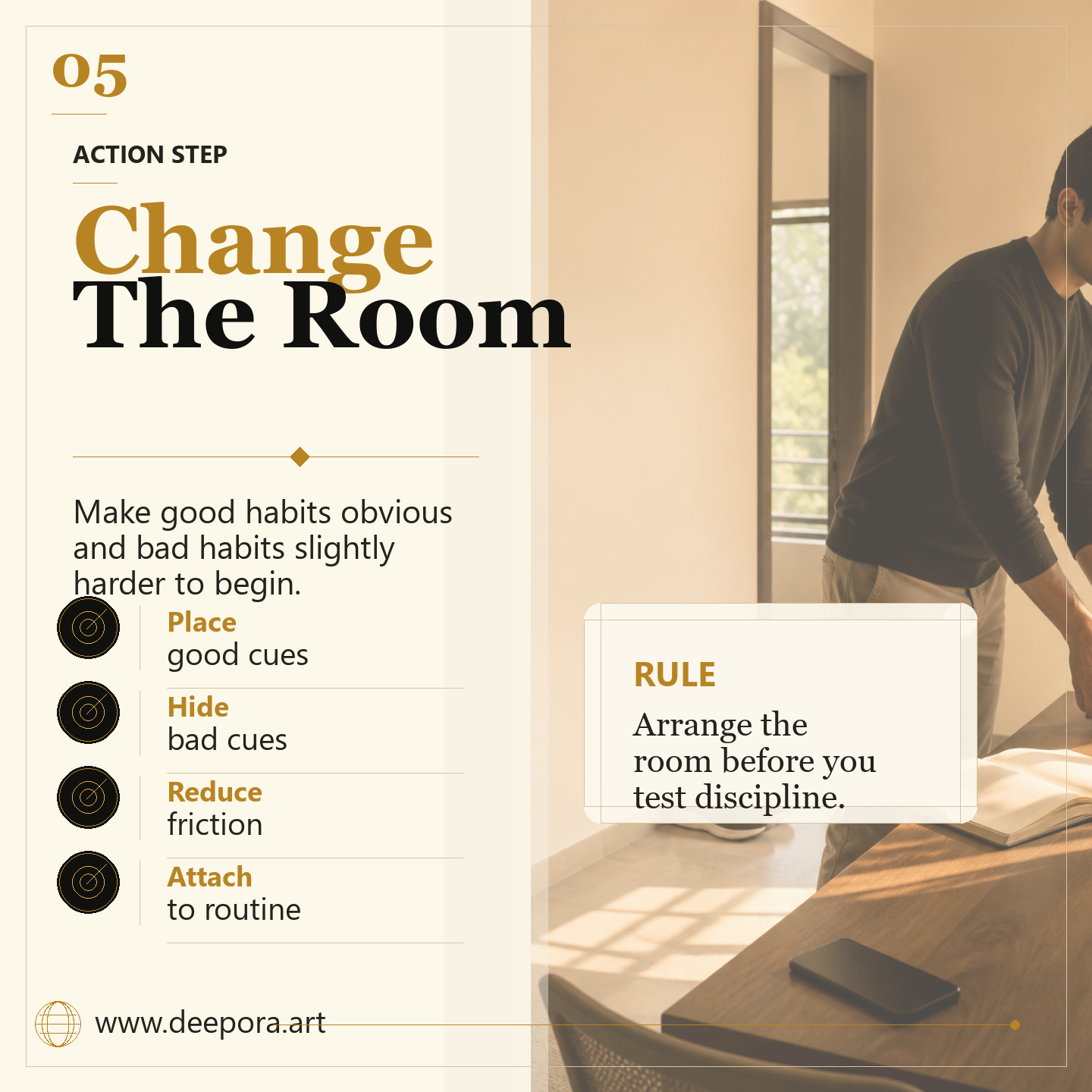
That is the heart of Atomic Habits environment design: many habits are not won in the moment of temptation. They are won earlier, when you arrange the room that will meet you at that moment.
What This Story Really Teaches
Most people think habit change is a battle between desire and discipline. If you fail to read, you need more discipline. If you skip exercise, you need more motivation. If you reach for the phone, you need stronger self-control.
James Clear challenges that view in Atomic Habits. His first law of behavior change is simple: make it obvious. A habit begins with a cue. If the cue is visible, close, and timely, the behavior becomes easier to start. If the cue is hidden, vague, or inconvenient, the behavior often disappears.
In one official James Clear article adapted from Atomic Habits, he explains that environment is the invisible hand that shapes human behavior. We like to believe we choose freely, but our choices are often pulled by what is visible, available, and easy around us.
This does not mean you have no responsibility. It means responsibility begins before the decision. A serious person does not only promise better choices. A serious person designs better conditions.
The Deep Idea: Your Environment Is a Silent Teacher
Your environment teaches you through repetition.
A chair beside the bed teaches "sit here and scroll." A clean desk teaches "start here." A water bottle near the laptop teaches "drink this." A charger outside the bedroom teaches "sleep without the phone." None of these cues feel dramatic. That is why they work. The best systems rarely feel heroic. They feel ordinary, almost boring, and repeatable.
Meera's mistake was trying to become a new person inside the same old room. Her phone stayed next to her pillow, then she expected a new morning routine. Her book stayed hidden, then she expected a reading habit. Her desk stayed chaotic, then she expected focused work.
It was not a character problem first. It was a design problem.
When she changed the design, her behavior began to change. She put her phone charger near the door. She kept a glass bottle on her desk. She placed her book on top of her pillow every morning, so at night it was impossible to miss. She kept her running shoes near the door. She left one notebook open on the exact page where tomorrow's first task was written.
Nothing magical happened. She did not become a different human overnight. But her room stopped fighting her. That was enough to begin.
Choice Architecture: The Research Behind the Lesson
James Clear often uses a hospital cafeteria study by Anne Thorndike and colleagues to explain choice architecture. The cafeteria changed how drinks were placed. Water became more available in more visible locations. According to Clear's summary, soda sales dropped by 11.4 percent while bottled water sales increased by 25.8 percent.
The lesson is not really about water. It is about defaults.
People did not attend a motivation seminar before choosing water. The environment simply made a better option easier to notice. That is why environment design is powerful: it works before your inner speech begins.
| Old Habit Logic | Environment Design Logic |
|---|---|
| "I need more willpower." | "I need fewer bad cues around me." |
| "I should remember to read." | "The book should be visible where I sit." |
| "I must stop using my phone." | "The phone should be harder to reach during focus time." |
| "I will exercise when I feel ready." | "My shoes and clothes should be ready before morning." |
| "I failed again." | "The system needs a better cue and less friction." |
The Cue Chain: How a Room Becomes a Habit
A cue is a signal that tells your brain, "This action belongs here."
That is why your behavior changes from room to room. You may feel focused in a library, distracted in bed, hungry in the kitchen, calm near a temple, and restless in a messy workspace. The place does not control you completely, but it gives your brain instructions.
| Habit You Want | Visible Cue | Friction Removed | Competing Cue Hidden |
|---|---|---|---|
| Read at night | Book on pillow | Bookmark ready | Phone charging outside room |
| Drink more water | Bottle on desk | Filled before work starts | Sugary drinks out of sight |
| Morning walk | Shoes near door | Clothes kept ready | Alarm placed away from bed |
| Deep work | Notebook open to first task | Desk cleaned at night | Social apps blocked during work block |
| Eat better | Fruit visible | Healthy snack pre-cut | Junk food not kept on desk |
10 Lessons From Atomic Habits Environment Design
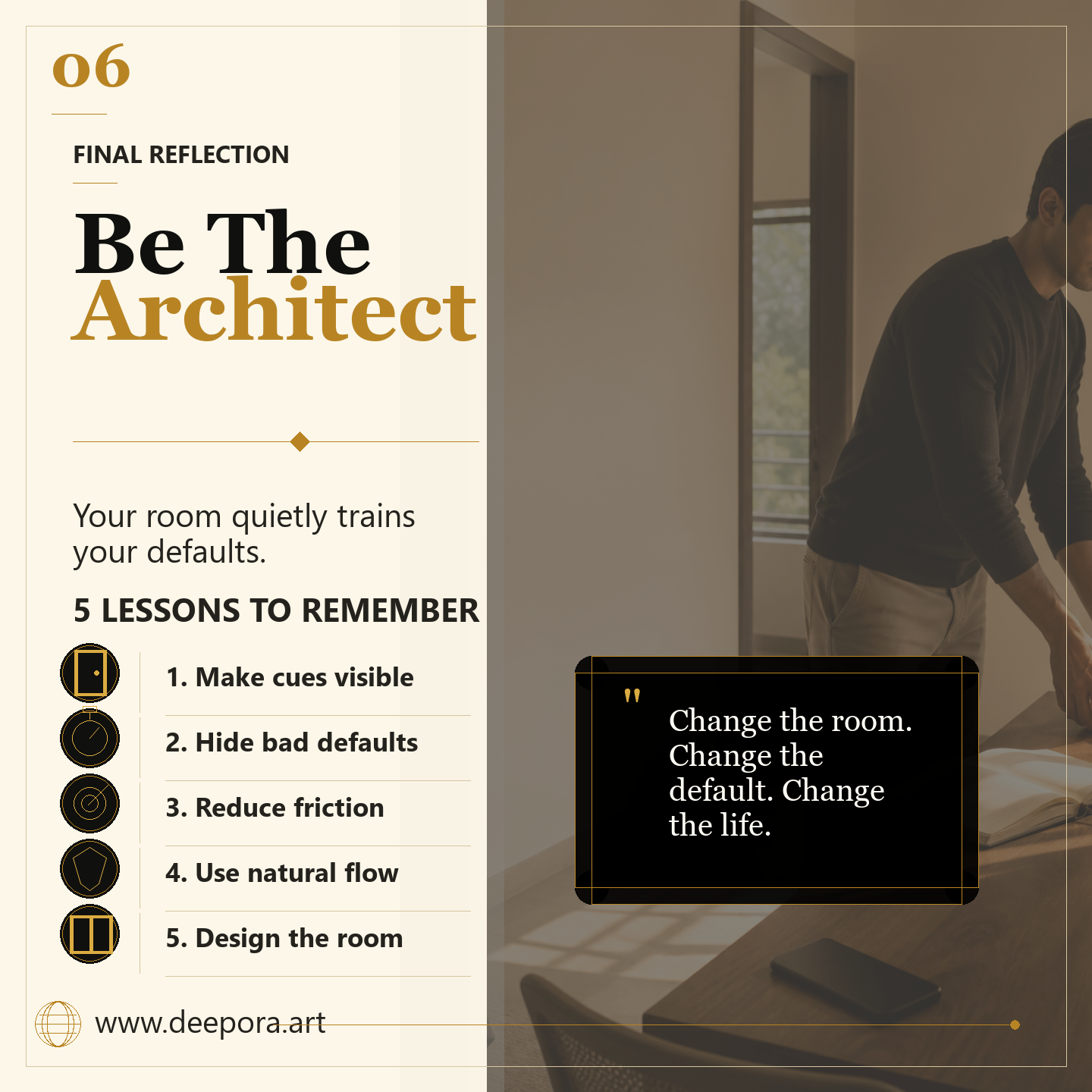
1. Your room is not neutral
Every space encourages some behaviors and discourages others. A cluttered desk does not just look messy. It creates mental drag. A visible book does not just decorate a table. It invites a small action.
2. Motivation is easier when the cue is obvious
If your guitar is inside a case under the bed, practice becomes a project. If it is on a stand near your chair, practice becomes a glance away. Obvious cues reduce the distance between intention and action.
3. Bad habits survive through easy access
Many bad habits are not stronger than you. They are closer than your good habits. The phone is closer than the book. The snack is closer than the fruit. The remote is closer than the shoes.
4. Friction is not your enemy. Badly placed friction is.
You want less friction for good habits and more friction for bad habits. Keep your journal open, but log out of distracting apps. Keep water visible, but keep late-night snacks out of the bedroom.
5. Design beats memory
People say, "I forgot." Often that means the cue was too weak. A strong environment remembers for you. The book on the pillow is a reminder. The shoes near the door are a reminder. The clean desk is a reminder.
6. One place should have one main job
If your bed is for scrolling, work, eating, and sleeping, your brain gets mixed instructions. If possible, give different spaces different jobs: desk for work, bed for sleep, chair for reading, dining table for eating.
7. The easiest option often becomes the default
People do what is easy more often than what is ideal. This is not weakness. It is human design. Use it. Make the good choice the easiest choice in the room.
8. Environment design is identity design
When your room supports reading, movement, focus, and calm, it becomes easier to believe, "I am the kind of person who lives this way." Identity is strengthened by repeated evidence.
9. You can redesign a habit without redesigning your whole life
Start with one corner, one drawer, one screen, one nightstand. Deep change often begins as a small rearrangement repeated long enough to become normal.
10. The best discipline is built before temptation
Do not wait until midnight to fight the phone. Move the charger at 8 p.m. Do not wait until morning to search for shoes. Place them near the door at night. The battle is easier when it starts earlier.
Instagram Carousel Summary
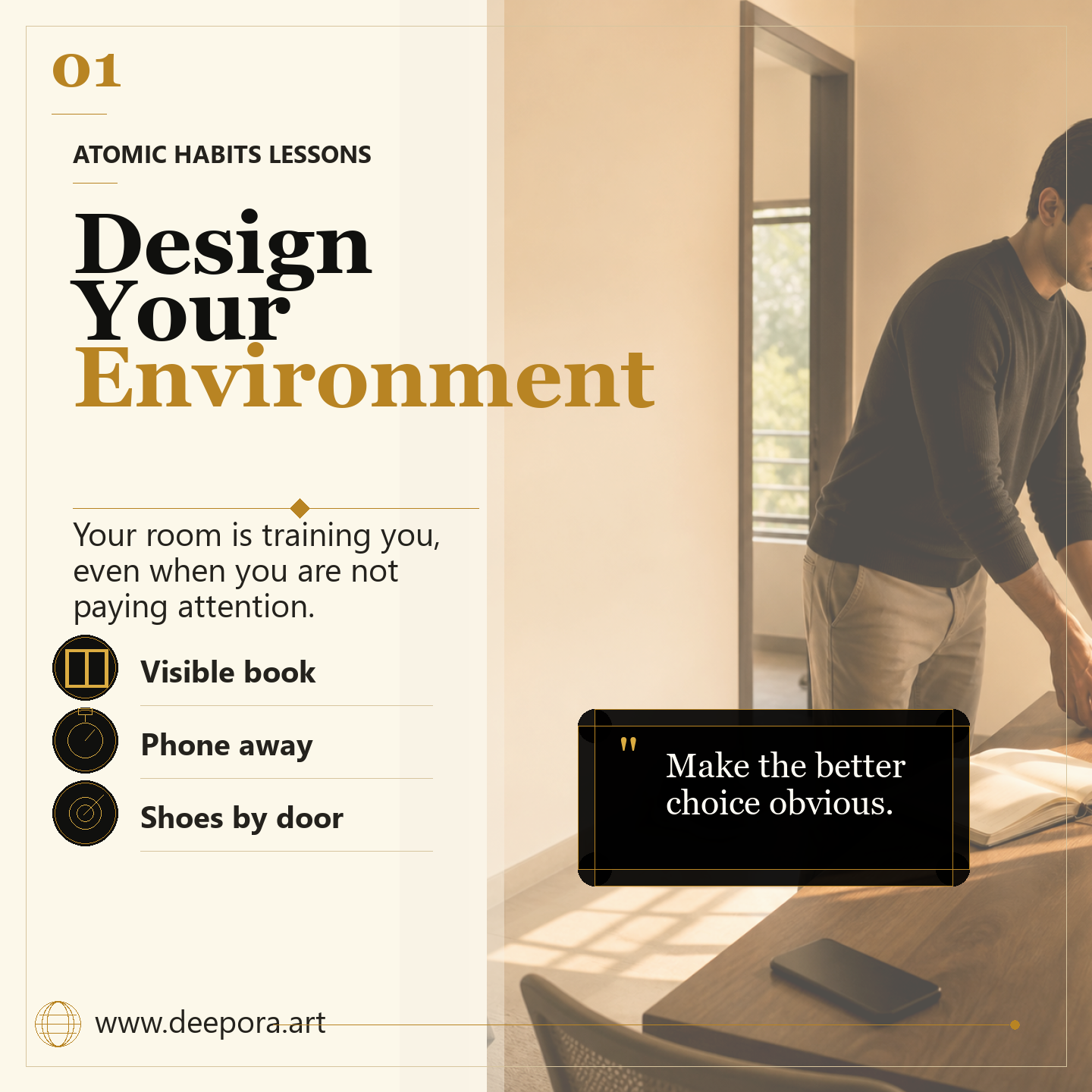
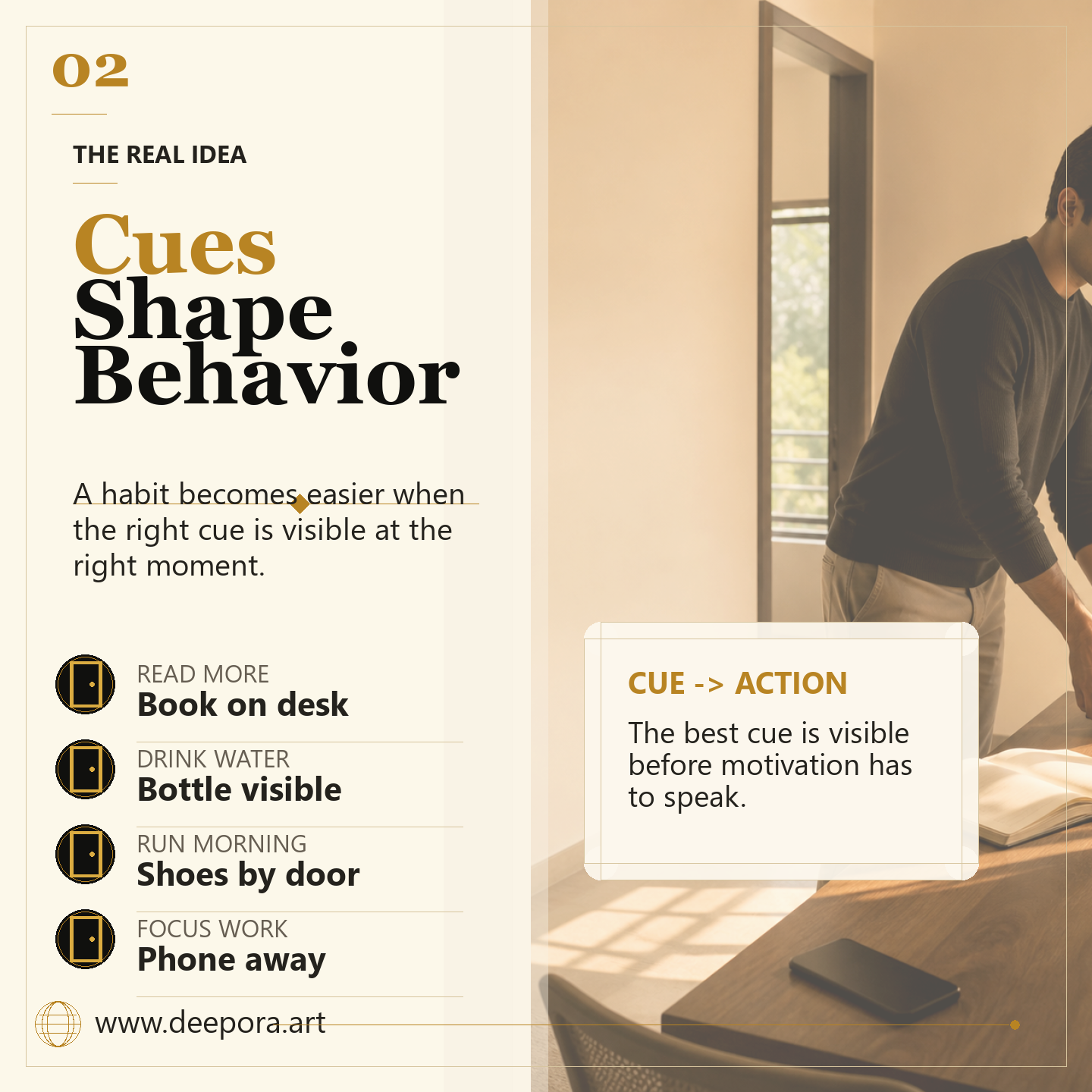
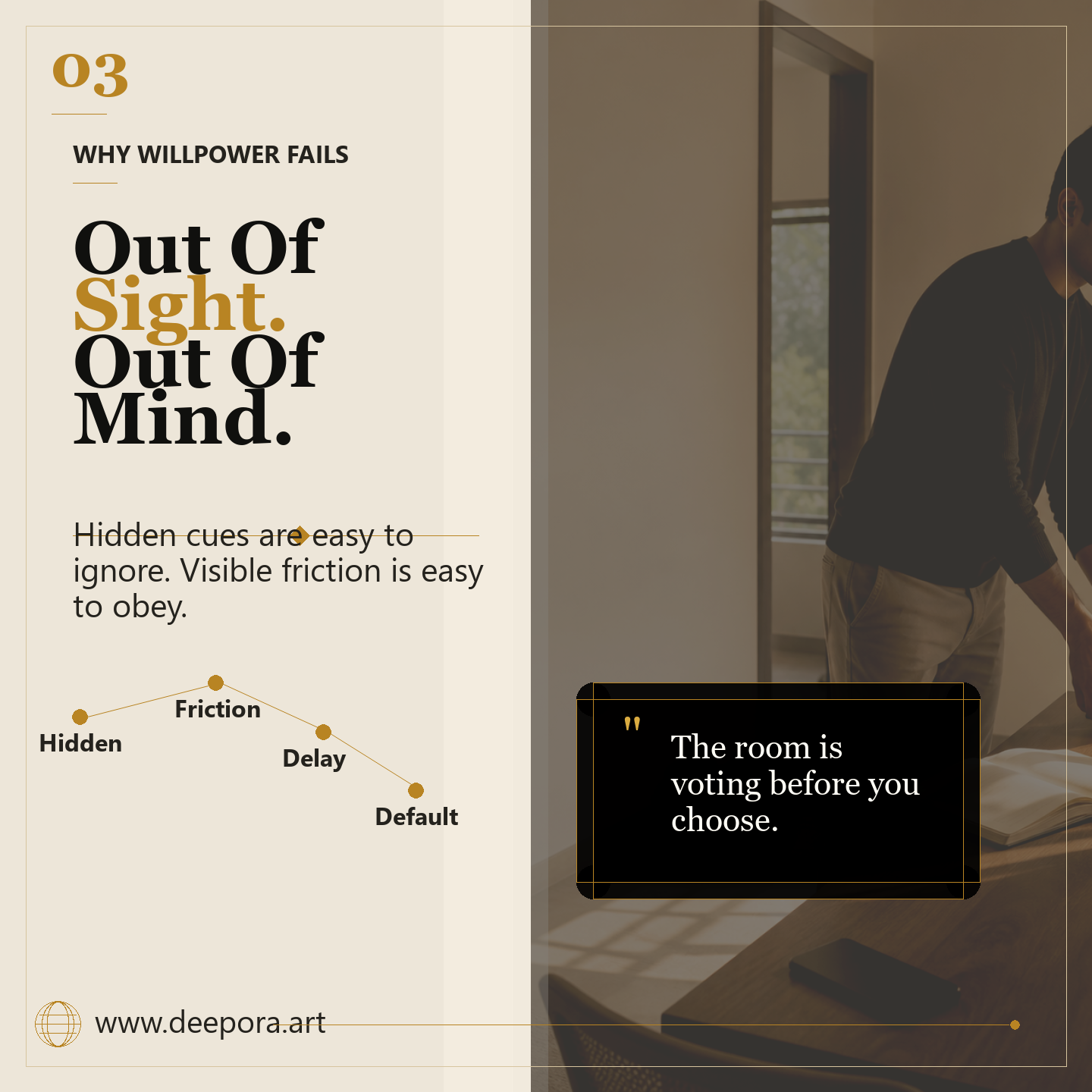
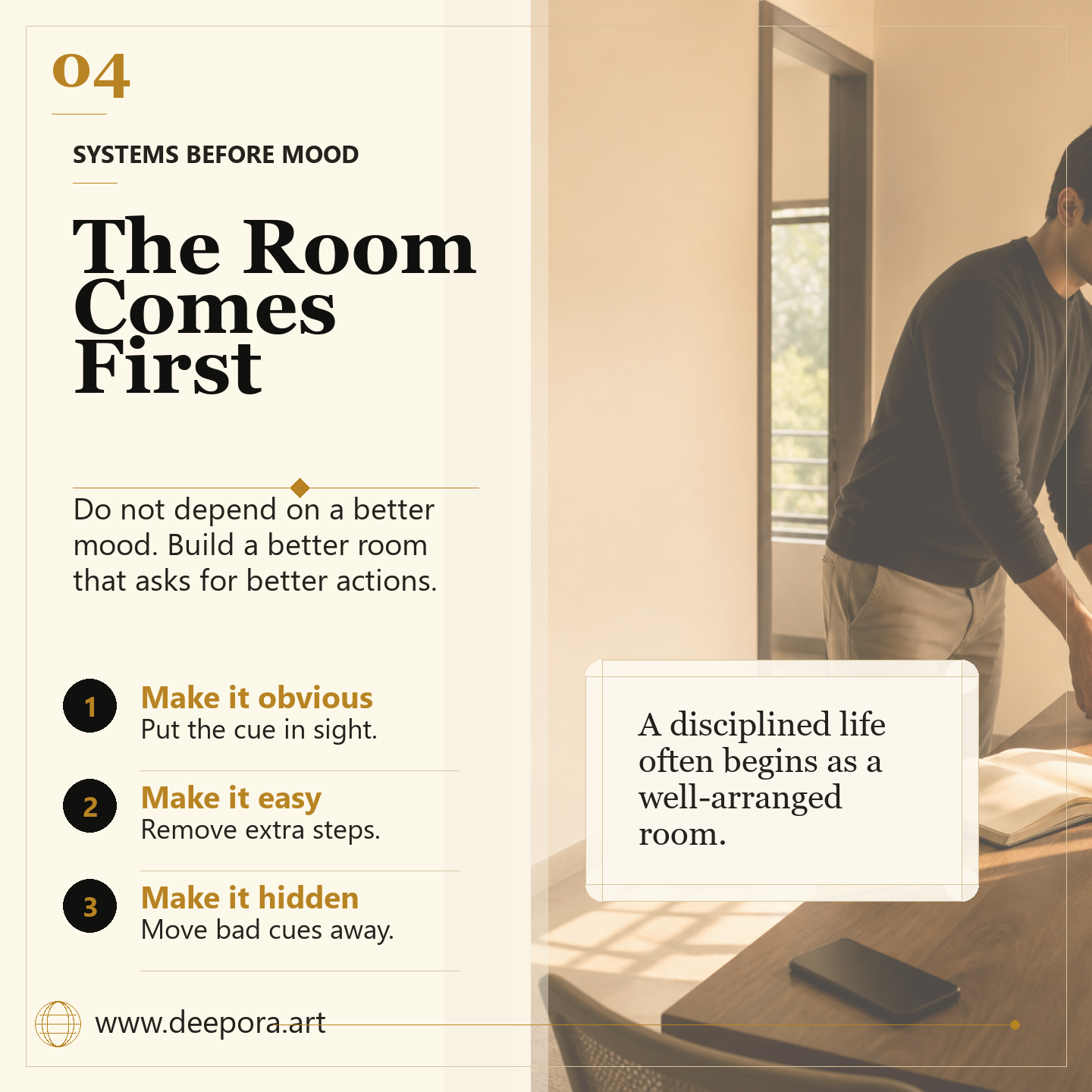
Room-by-Room Environment Design
Bedroom
If sleep is the goal, the phone cannot be the first object your hand finds. Charge it away from the bed. Put a book or journal where the phone used to be. Keep tomorrow's clothes visible so morning has fewer decisions.
Work Desk
Your desk should tell you the next action in one glance. Clear yesterday's clutter. Leave one notebook open. Write the first task before you stop working. Keep water visible. Put distracting devices outside arm's reach.
Kitchen
Put better food at eye level. Keep fruit washed and visible. Do not keep high-friction healthy choices hidden behind low-friction junk choices. Your future hunger will not be more philosophical than your present hunger.
Phone Home Screen
Your digital environment is still environment. Move distracting apps away from the first screen. Keep learning, writing, reading, or meditation apps visible. Turn your home screen into a cue board, not a trap.
A Practical 7-Day Environment Design Challenge
- Day 1: Pick one habit you want to make obvious.
- Day 2: Place its cue where you already spend time.
- Day 3: Remove one step that makes the habit hard to start.
- Day 4: Hide one cue that triggers the opposite behavior.
- Day 5: Prepare the environment at night for tomorrow morning.
- Day 6: Notice which cue worked without needing motivation.
- Day 7: Keep the setup that worked and remove the setup that failed.
The Meera Test
Before sleeping, Meera now asks one question: "What will my room make easy tomorrow?"
If the answer is scrolling, she moves the phone. If the answer is confusion, she writes the first task. If the answer is skipping the walk, she places the shoes near the door. If the answer is forgetting to read, she puts the book on the pillow.
This question is small, but it changes the direction of the next day. It turns habit change from a speech into a setup.
Related Deepora Reads
- Atomic Habits Small Changes: Why Tiny Habits Compound
- Atomic Habits 2 Minute Rule: The Small Start That Beats Procrastination
- Ego Is the Enemy Lessons: Why Success and Failure Both Test You
- Zero to One Lessons: Stop Competing, Start Building
FAQ: Atomic Habits Environment Design
What is the main lesson of environment design?
The main lesson is that your surroundings should make good habits obvious, easy, and natural. Instead of relying only on motivation, you arrange cues and defaults that pull you toward the behavior you want.
Is environment design the same as discipline?
No. Discipline is still useful, but environment design reduces how much discipline you need. It builds a system where the better action is easier to start.
Can environment design help with phone addiction?
Yes, if you treat the phone like a cue machine. Charge it away from the bed, remove addictive apps from the home screen, use app limits, and create phone-free zones for sleep and work.
What is a good first habit to redesign?
Choose a habit that happens daily and depends on a visible cue: reading, water, walking, journaling, studying, or deep work. Daily habits give fast feedback.
How long does environment design take to work?
You may notice a difference immediately because cues change quickly. But the identity shift takes repetition. Give one setup at least seven days before judging it.
Reflection Prompt
Look around the room you are in right now. What behavior is this room making easy? What behavior is it making hard?
Now choose one object to move before the day ends.
Move the phone. Place the book. Fill the bottle. Open the notebook. Put the shoes near the door.
Do not redesign your entire life tonight. Redesign one cue.
Sources, Credit, and Disclaimer
This Deepora article is an original educational story inspired by Atomic Habits by James Clear and his public writing on environment design, choice architecture, and habit cues. The character Meera is fictional and used for learning purposes. For the original concepts, read James Clear's official resources: Atomic Habits, Motivation is Overvalued. Environment Often Matters More., and Choice Architecture.
This is not medical, psychological, financial, or professional advice. It is a storytelling and self-improvement guide. If a habit is connected to addiction, mental health, or a serious life issue, consider speaking with a qualified professional.
Conclusion: Change the Room Before You Judge Yourself
The next time you fail a habit, do not rush to insult your character. Ask a better question: "What made the wrong action easy?"
Then fix that.
Atomic Habits environment design is not glamorous. It is not a dramatic transformation montage. It is a water bottle on the desk. A phone outside the bedroom. A book on the pillow. Shoes by the door. A notebook open to tomorrow's first task.
Small designs create small starts. Small starts create repeated evidence. Repeated evidence creates identity.
You do not only live in your environment. Slowly, quietly, daily, you become the kind of person your environment keeps asking you to be.
Deepora action: Before you leave, choose one habit and redesign one cue for it today.
0 Comments