
The hardest thing about small habits is not doing them.
The hardest thing is believing they matter while they still look unimpressive.
A person can understand the logic of compound growth and still quit after eight days because nothing visible has changed. The mirror looks the same. The bank balance looks the same. The page still feels blank. The skill still feels awkward. The result does not arrive fast enough to emotionally justify the effort.
That is why the lesson from Atomic Habits is not simply "small habits are good." Everyone already knows that. The deeper lesson is that small habits require a different kind of faith: not blind optimism, but trust in a system before the system has produced visible proof.
The boy who kept restarting his life
There was a student named Kabir who had a familiar problem. Every few months he became serious about changing his life.
He would buy a new notebook. He would clean his desk. He would write a timetable with impressive blocks of discipline: wake up at 5:00, study for three hours, exercise, read, revise, sleep early. The plan always looked like a better version of him had designed it.
For the first two days, he followed it. On the third day, he missed one block. On the fourth, he slept late. By the fifth, the plan had become evidence against him. It did not inspire him anymore. It accused him.
So he abandoned it.
Then, after enough guilt had collected, he repeated the cycle. New notebook. New plan. New version of himself. Same collapse.
Most people do not fail because they have no desire to improve. They fail because their system only works for the version of themselves that exists on motivated days.
James Clear's Atomic Habits is useful because it starts from a more honest premise: your system must be built for ordinary days. Not perfect days. Not dramatic days. Ordinary days.
The problem with trying to change dramatically
Kabir believed intensity was proof of seriousness. If the plan did not hurt, it did not feel real. If the goal did not demand a complete transformation, it felt too small to respect.
But intensity has a weakness: it depends on emotional weather.
When energy is high, intensity feels possible. When life becomes normal, intensity becomes expensive. A habit that requires perfect mood is not a habit. It is a performance.
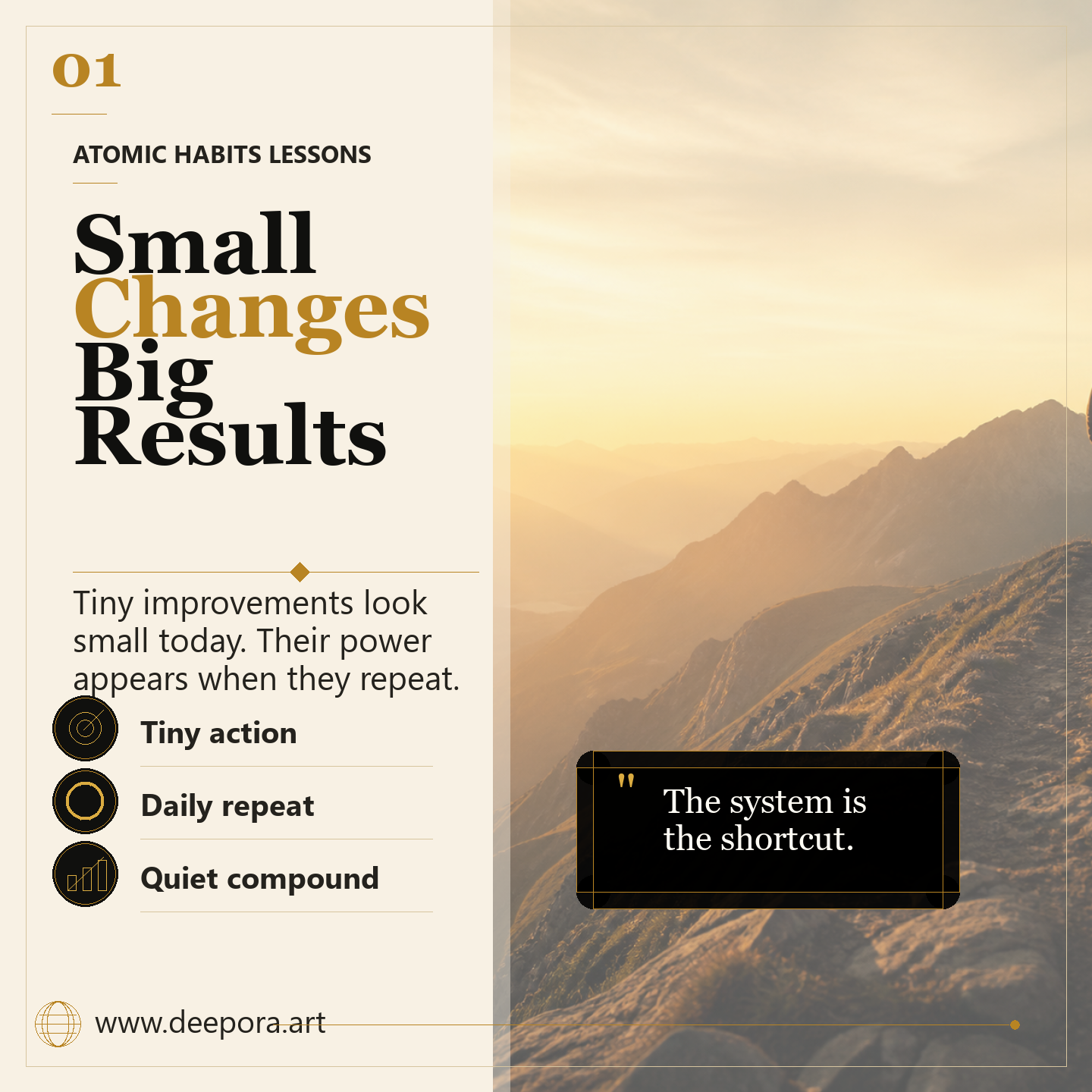
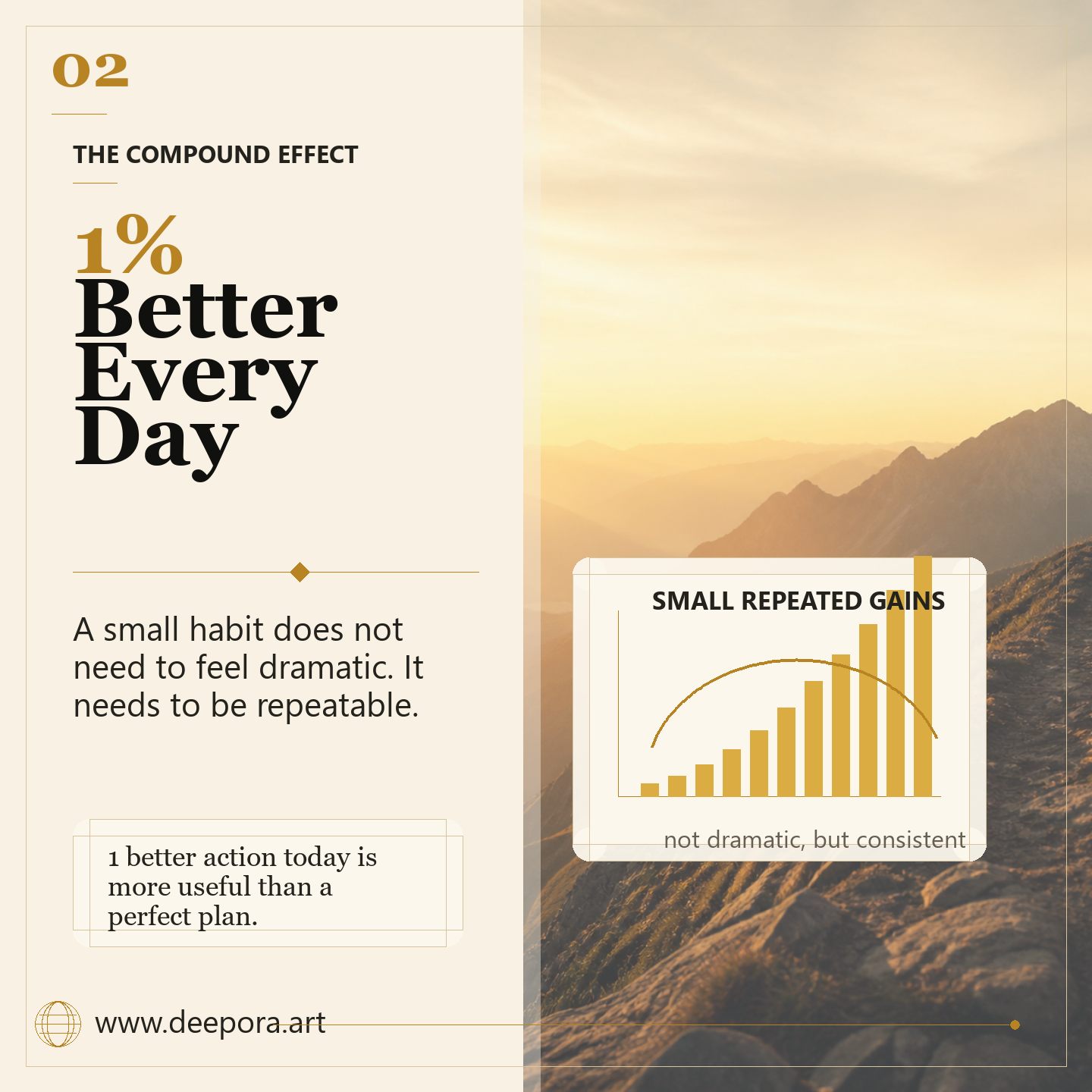
This is where the idea of atomic habits small changes becomes practical. A small change is not weak because it is small. It is strong because it can be repeated. Repetition is the bridge between intention and identity.
Kabir did not need a three-hour study block at the beginning. He needed ten minutes after dinner that he could repeat without negotiating. He did not need to become a disciplined person in one week. He needed to collect evidence that he was someone who returned.
The first habit that actually stayed
His first working habit was almost embarrassing.
After dinner, he opened his book and studied for ten minutes.
That was it.
No dramatic music. No perfect desk setup. No three-hour promise. Ten minutes after dinner.
At first, he did not trust it. It felt too small to matter. But that was exactly why it survived. On tired days, ten minutes was possible. On busy days, ten minutes was possible. On days when he did not feel like changing his life, ten minutes was still possible.
After two weeks, something shifted. The habit was no longer a decision. Dinner ended, and his body knew what came next. The cue had become stronger than his mood.
That is the hidden power of small habits: they reduce the number of times you have to convince yourself.
Why results lag behind effort
Kabir still did not see big results immediately. This is the part most motivational advice skips.
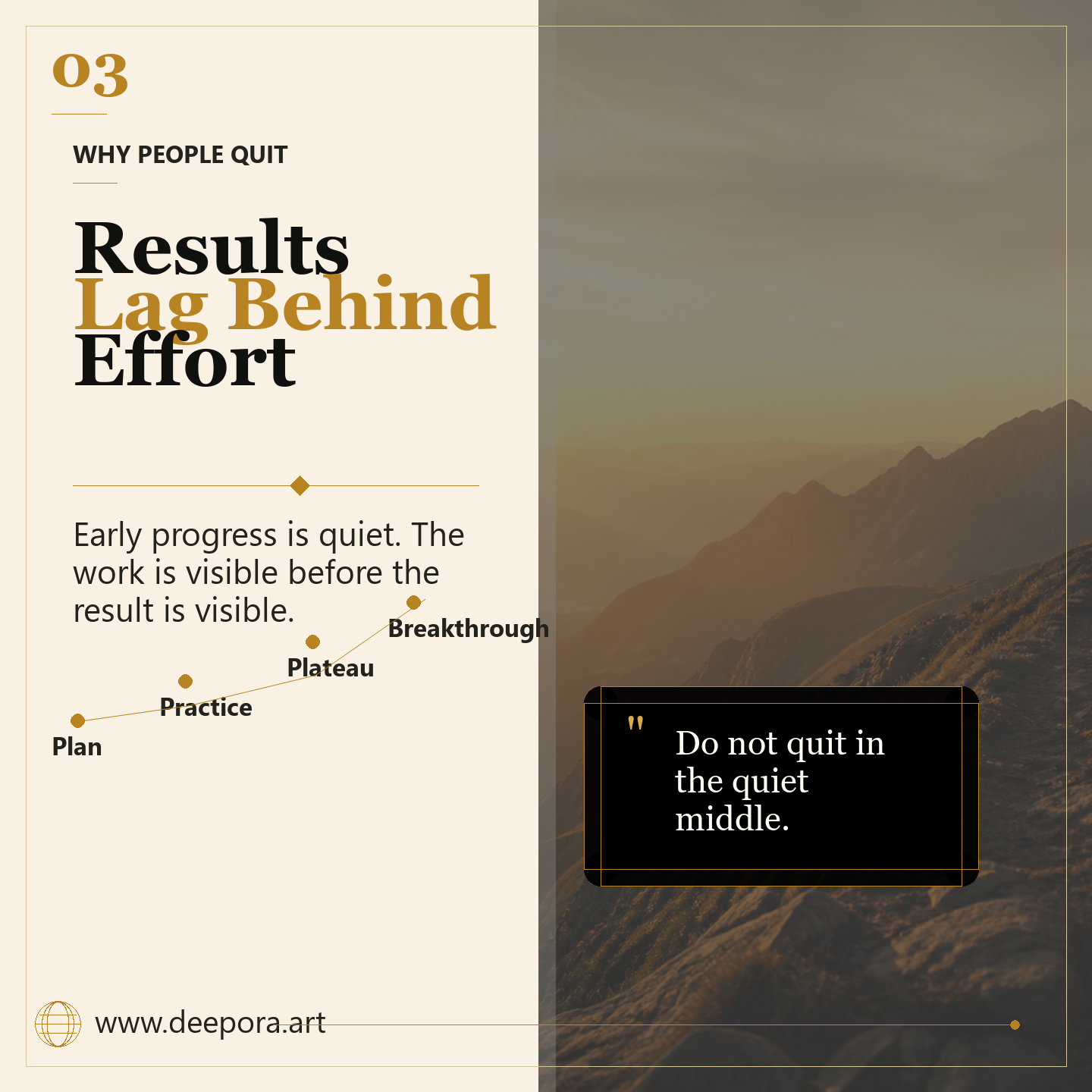
Small habits do not always reward you quickly. For a while, effort and results live in different timelines. You are doing the work now, but the visible proof arrives later. This gap is where most people quit.
James Clear calls attention to the plateau that appears before noticeable change. You do the habit, repeat the habit, protect the habit, and still feel ordinary. The mistake is assuming nothing is happening because nothing is visible.
But something is happening.
Your environment is being trained. Your identity is being updated. Your friction is being reduced. Your attention is learning where to go. Your future self is receiving small deposits that do not look impressive one at a time.
Compound growth is boring before it is obvious.
Identity is built by evidence
The most important change in Kabir was not that he studied more. It was that he stopped calling himself inconsistent.
Not because someone gave him a speech. Not because he suddenly became a different person. Because he had evidence.
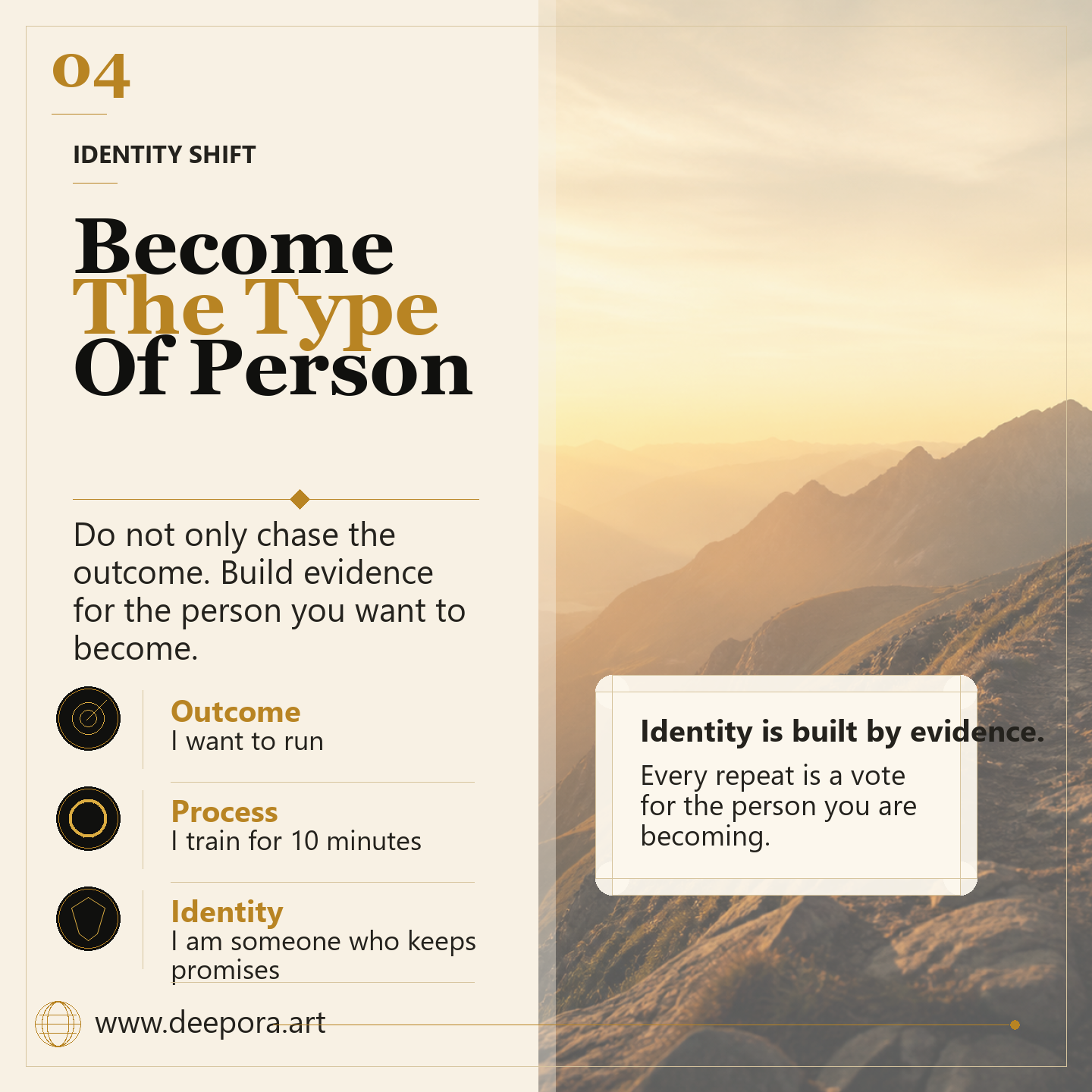
Every night he studied for ten minutes, he cast a vote for a new identity. Not a grand identity. Not "topper," not "genius," not "future success story." Something more practical: "I am someone who keeps this appointment."
That identity was small, but it was stable.
This is one of the strongest ideas in Atomic Habits: behavior and identity feed each other. You do not need to wait until you fully believe a new identity. You build belief by giving yourself proof.
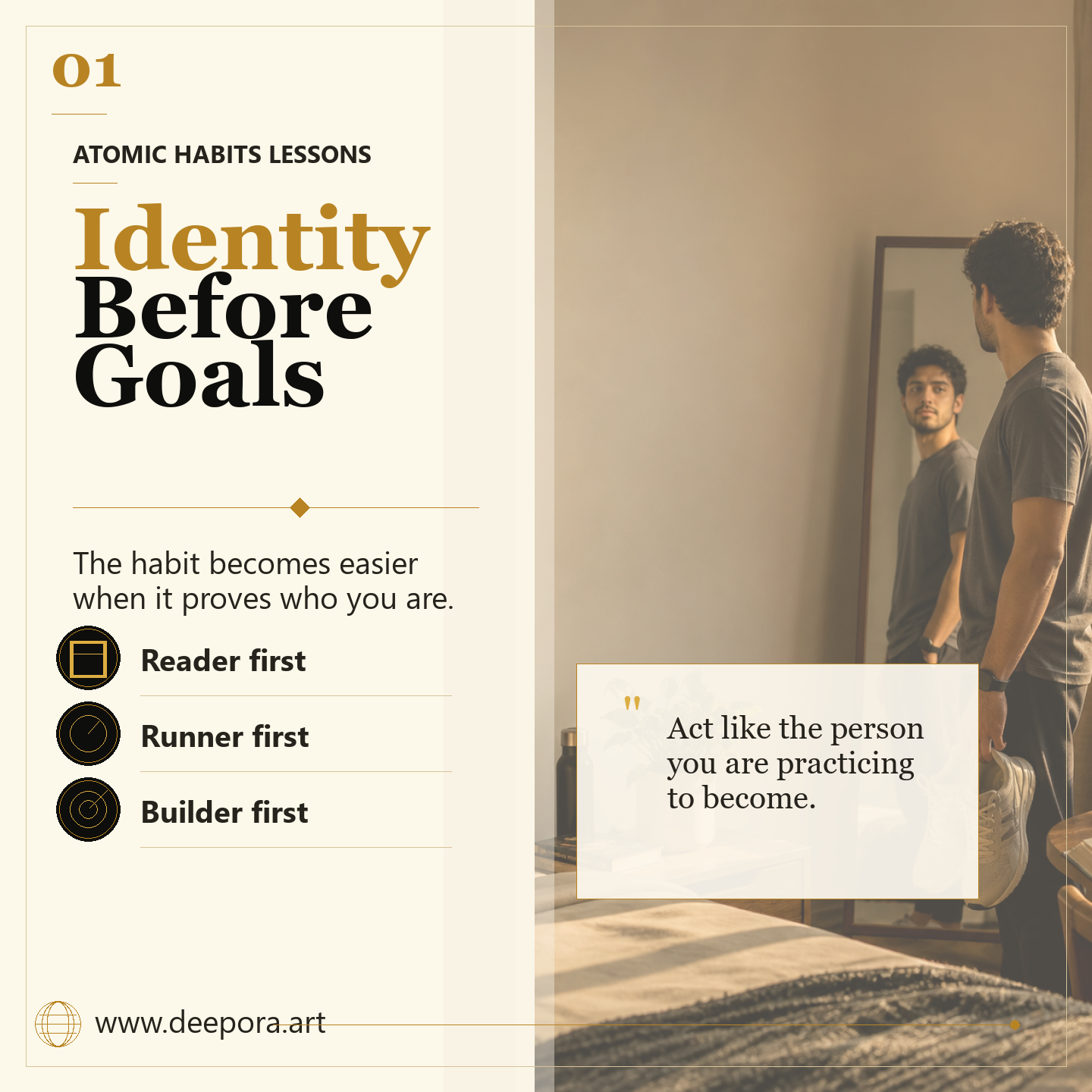
A writer becomes a writer by writing. A runner becomes a runner by running. A disciplined student becomes disciplined by keeping small promises long enough for the evidence to become hard to deny.
The habit loop in real life
Most habits follow a simple loop: cue, craving, response, reward.
For Kabir, the cue was dinner ending. The craving was not "I want to study." That would have been too fragile. The craving became "I want to keep the chain alive." The response was ten minutes of study. The reward was crossing the day off on a small calendar.
Notice how ordinary this is.
That is why it worked. The system did not depend on a heroic mood. It depended on a clear trigger, a small action, and a visible reward.
What small habits are not
Small habits are not an excuse to think small forever.
The goal is not to read two pages for the rest of your life if you can read more. The goal is to make starting automatic. Once the habit exists, it can expand naturally. But if you try to expand before the habit is stable, you often destroy the thing you are trying to build.
A seed is not a tree. But a tree without a seed is just imagination.
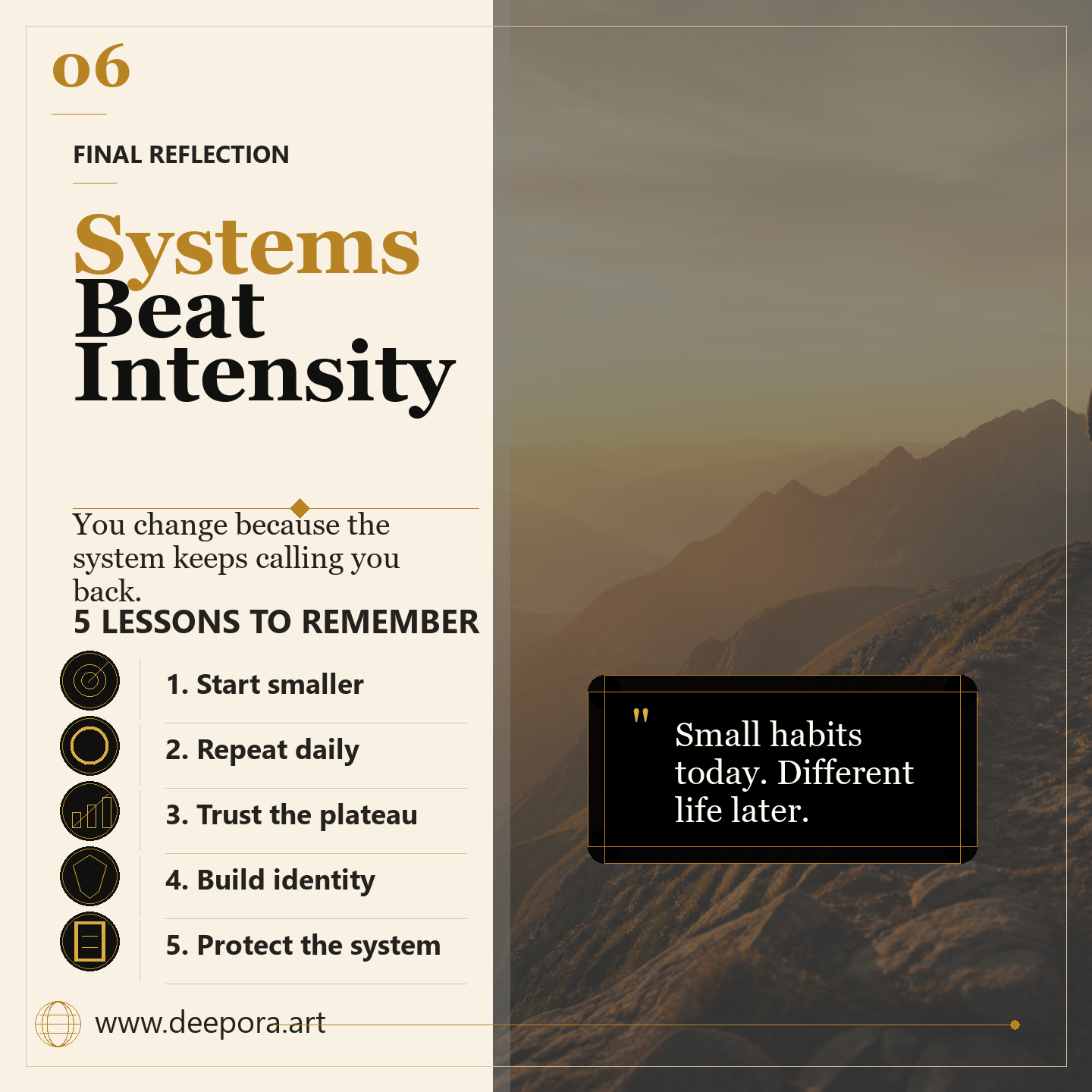
Systems beat goals
Kabir's old plans were goal-heavy. They described the life he wanted. His new system described the behavior that would make that life more likely.
Goals give direction. Systems create motion.
A goal says: score better marks. A system says: study ten minutes after dinner, review mistakes every Sunday, keep the book visible, put the phone in another room.
A goal says: become fit. A system says: walk after lunch, sleep at a fixed time, keep shoes by the door.
A goal says: write a book. A system says: write 200 words before opening messages.
The system is where identity becomes operational.
What this story really teaches
The Deepora lesson is this: do not judge a habit by how impressive it looks on day one. Judge it by whether it can survive day thirty.
The small version is not the weak version. The small version is the version that can pass through real life without breaking. Once it survives, it earns the right to grow.
Atomic Habits distilled: 10 practical lessons
Lesson 01: Make the habit obvious
A habit hidden inside vague intention rarely survives. Attach it to a specific cue: after dinner, after tea, before opening Instagram, after brushing your teeth.
Lesson 02: Make it easy
Reduce the first step until starting feels almost effortless. The first battle is not maximum effort. It is reducing resistance.
Lesson 03: Make it satisfying
Your brain repeats what feels rewarding. Use a visible checkmark, a small tracker, or a simple moment of completion to close the loop.
Lesson 04: Start with identity
Do not only ask what result you want. Ask who you are becoming through the repeated action.
Lesson 05: Never miss twice
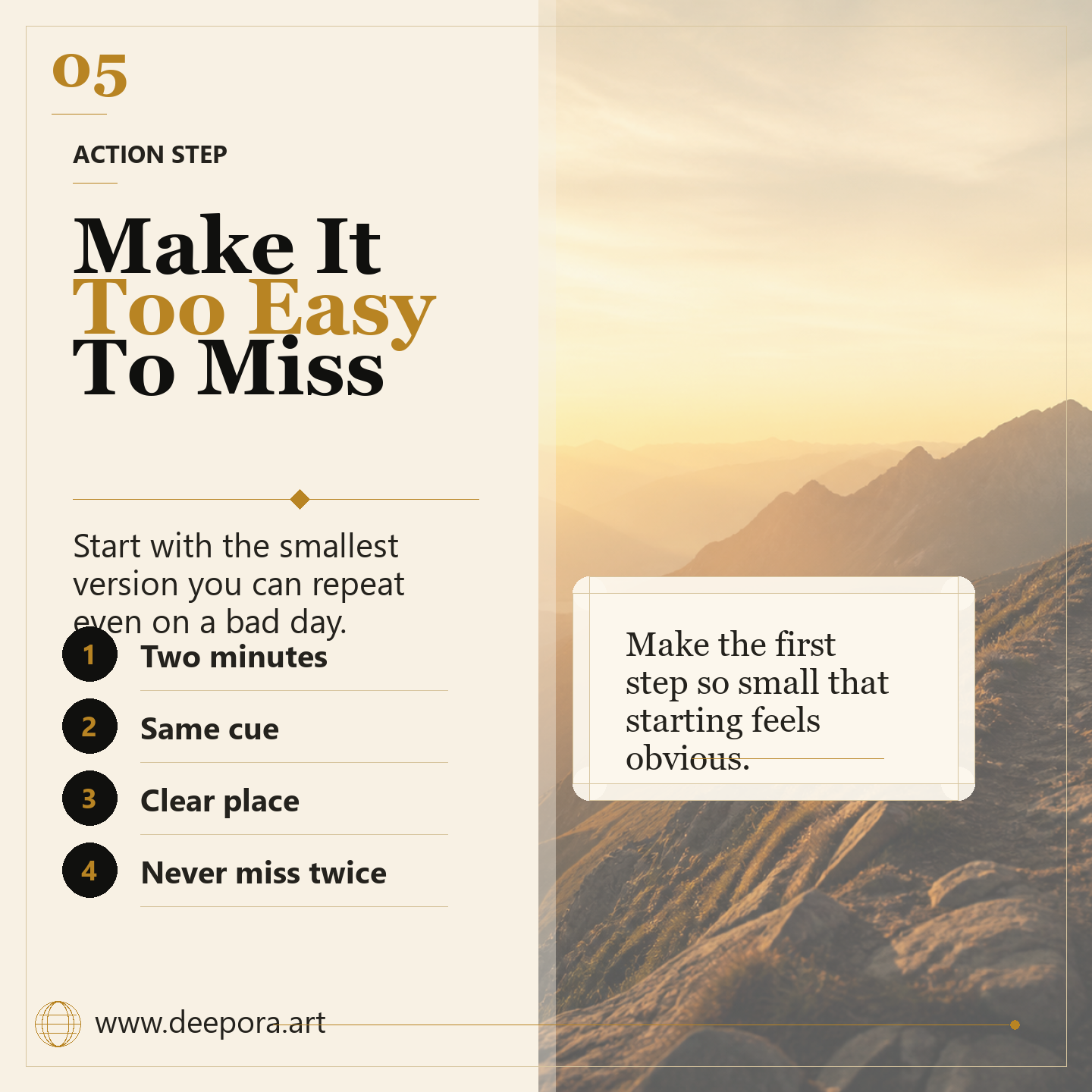
Missing once is normal. Missing twice is the beginning of a new pattern. Return quickly, even with a smaller version.
Lesson 06: Design the environment
Discipline becomes easier when the environment reduces friction. Keep the right action visible and the wrong action slightly harder.
Lesson 07: Respect the plateau
Results often arrive after the work has already been repeated for longer than your emotions expected.
Lesson 08: Track the smallest proof
A tracker is not magic. It is evidence. Evidence protects identity when motivation drops.
Lesson 09: Reduce before you quit
If the habit feels too heavy, do not abandon it. Shrink it until it can survive.
Lesson 10: Let the system carry you
The goal is not to feel motivated every day. The goal is to build a system that knows what to do when motivation is absent.
Small change examples
| Goal | Too heavy | Atomic version |
|---|---|---|
| Read more | Read one hour daily | Read two pages after dinner |
| Get fit | Full workout every morning | Walk for five minutes after lunch |
| Write consistently | Write 1000 words daily | Write 100 words before messages |
| Save money | Perfect monthly budget | Track one expense category daily |
| Study better | Three-hour study block | Ten minutes after dinner |
Daily practices to build
The two-minute start
Before making a habit bigger, make it automatic. Read one paragraph. Put on the shoes. Open the document. The point is to train the start.
The visible cue
Place the habit where your day will see it. A closed book inside a drawer is a weak cue. An open book on the desk is stronger.
The friction audit
Ask: what makes this habit harder than it needs to be? Remove one step. Prepare one object. Block one distraction.
The Sunday review
Once a week, check the system, not your worth. Did the cue work? Was the habit too large? Did the environment help or fight you?
Practical action steps
- Choose one habit you have failed to maintain.
- Reduce it until it can be done in two to ten minutes.
- Attach it to one existing daily cue.
- Make the first action visible before the cue arrives.
- Track completion for seven days without increasing the habit.
- If you miss one day, return the next day with the smallest version.
Instagram Carousel Summary
Save this visual summary for the practical ideas from the article.
Frequently Asked Questions
What does Atomic Habits mean by small changes?
Small changes are tiny repeatable behaviors that compound over time. Their strength comes from consistency, not drama.
Why do small habits work better than big goals?
Big goals give direction, but small habits create repeatable motion. A system that survives ordinary days is more useful than a plan that only works when motivation is high.
How long does it take for tiny habits to show results?
Visible results vary, but the first change is often identity. You begin seeing yourself as someone who keeps small promises. That identity makes future action easier.
Reflection prompt
Which habit in your life keeps failing because you made it impressive before you made it repeatable?
Go deeper
Read James Clear's work at jamesclear.com/atomic-habits. For a related Deepora lesson on staying teachable while improving, read Ego Is Your Worst Enemy.
Disclaimer: This article is an educational Deepora adaptation inspired by themes from Atomic Habits by James Clear. Kabir is a fictional composite character created for storytelling. Full credit for the original habit frameworks belongs to James Clear and his published work.

0 Comments